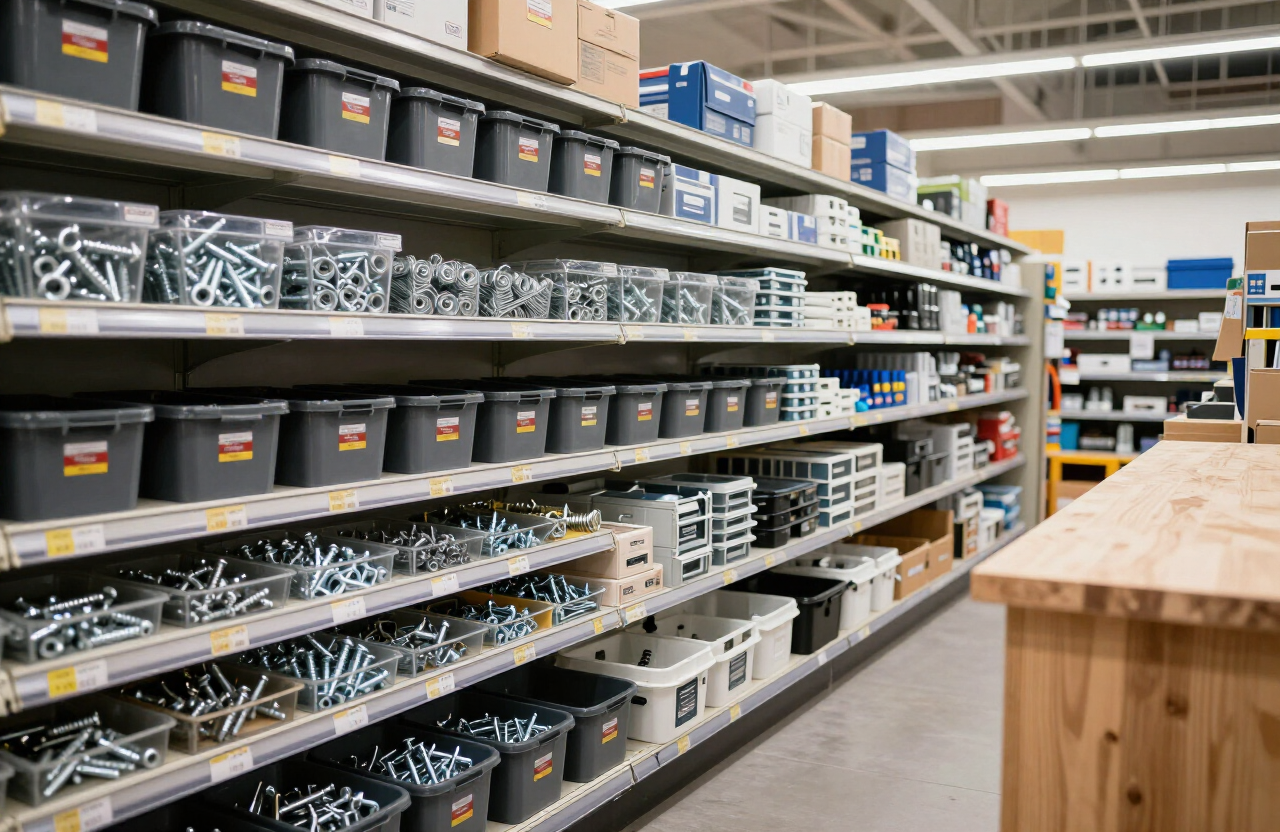
For a local builders’ merchant, screws, fixings and ironmongery can be frequent-purchase lines with a meaningful effect on margin and customer value. Buying more efficiently does not simply mean ordering the largest quantity available: it means understanding demand, consolidating suitable volume, comparing like-for-like quotations and checking that any trade discount works after delivery, storage and stock risks are considered. This guide explains how economies-of-scale purchasing may help, without assuming a particular discount or saving.
Why high-volume fixings deserve a closer look
A single box of screws or a small item of door ironmongery may represent a modest spend, but repeat orders across a branch, trade counter or several projects can add up. When these purchases are made ad hoc, the merchant may be paying different prices for the same or similar specification, missing volume breaks, or absorbing avoidable delivery charges. A structured review can show whether the current buying pattern is competitive.
What economies of scale means in this context
Economies of scale arise when a supplier can offer more favourable commercial terms because the buyer provides a larger, more predictable or more consolidated order. For a builders’ merchant, that might mean combining demand for common screw sizes across branches, agreeing a scheduled delivery programme, or committing to a defined range of ironmongery rather than buying one-off items at standard trade-counter rates. The benefit could appear as a lower unit price, a rebate, reduced delivery charges or more stable terms — it is not necessarily a single headline discount.
Start with a reliable demand picture
Before asking a supplier for a bulk trade discount, review purchasing data for the last 12 months where available. Separate screws, fixings and ironmongery by product, specification, pack size, quantity, supplier and delivery cost. Identify fast-moving lines, seasonal demand, emergency purchases and products that are regularly substituted. This prevents an apparently attractive price on a slow-moving item from creating excess stock.
- Rank products by annual quantity and total cost, not unit price alone
- Group genuinely comparable products by grade, finish, size and certification
- Separate predictable core demand from project-specific or seasonal demand
- Record stockholding, write-offs, returns and urgent delivery patterns
- Check whether buying is fragmented between branches, teams or suppliers
Consolidate volume without overstocking
Volume can often be consolidated without placing one oversized order. A merchant might combine branch demand, use a quarterly call-off arrangement, or agree scheduled deliveries against an indicative forecast. This can give the supplier better visibility while allowing the buyer to match stock to actual sales. Any arrangement should define minimum order quantities, call-off flexibility, lead times, storage capacity and what happens if demand changes.
Compare quotations on a like-for-like basis
A credible comparison needs the same product specification and commercial assumptions for every supplier. Ask for quotations covering the agreed screw, fixing or ironmongery range, expected volume, pack size, delivery location and ordering schedule. Compare the delivered cost rather than the catalogue price, and make clear whether VAT, carriage, rebates and payment terms are included or separate.
The incumbent supplier should normally be included in the review. Sharing a clear, evidence-based requirement gives an existing supplier an opportunity to improve its terms, while alternative quotations provide a useful market reference. A new supplier is not automatically better if its product quality, availability or delivery performance is weaker.
Look beyond the unit price
- Product quality, coating, grade, dimensions and any relevant standards
- Availability, lead times and the supplier’s ability to handle urgent requirements
- Delivery charges, minimum order values and branch drop arrangements
- Payment terms, rebates, price-review clauses and the length of any fixed rate
- Returns, damaged goods, packaging and support for obsolete or substituted lines
- Stockholding requirements and the working-capital cost of buying ahead
For a builders’ merchant, service continuity matters because an unavailable fixing can delay a customer’s job and lead to an emergency purchase at a less favourable rate. The right comparison therefore weighs total cost and operational reliability together, rather than selecting the lowest number on a quotation.
Put the agreement under review
A bulk-buying arrangement should have a review point. Track actual volumes against the forecast, confirm that agreed prices appear on invoices, and check whether delivery and product availability match the agreement. Revisit the market when the contract or price list is due for review, when demand changes materially, or when a product range is replaced. This keeps the merchant from becoming dependent on an outdated assumption about volume or value.
A practical review process
- 1Extract purchase history for screws, fixings and ironmongery by product and supplier
- 2Confirm the required specification, quality, pack size and delivery pattern
- 3Identify where branch or project demand can be consolidated safely
- 4Request comparable quotations from the incumbent and credible alternatives
- 5Compare delivered cost, service, stock risk and contract terms together
- 6Agree measurable terms and review them against actual purchasing performance
Frequently asked questions
- Does buying in bulk always produce a better result?
- No. The outcome depends on demand certainty, product shelf life, storage, working capital, delivery terms and the supplier’s pricing structure. A smaller scheduled or consolidated order may be more suitable than holding excessive stock.
- Should a local builders’ merchant change supplier to secure a trade discount?
- Not necessarily. The existing supplier should usually be benchmarked first. A clear volume requirement and credible comparison may improve incumbent terms without a switch, provided product quality and availability remain suitable.
- What information is useful for a purchasing review?
- Recent invoices or a purchase export for screws, fixings and ironmongery, together with product specifications, quantities, delivery charges and any current trade-account terms. Sensitive commercial information can be reviewed selectively at the initial stage.


